Sound Figures by Theodor W. Adorno
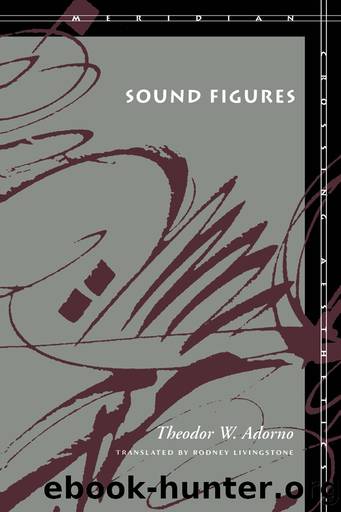
Author:Theodor W. Adorno [Adorno, Theodor W.]
Language: eng
Format: epub
Tags: music, Instruction & Study, Theory
ISBN: 9781503615335
Google: WYztDwAAQBAJ
Publisher: Stanford University Press
Published: 1999-06-03T23:48:49.111812+00:00
§ The Function of Counterpoint in New Music
For Rudolf Kolisch, in true friendship
Just as the speculative eye sees things together, so the speculative ear hears things together.
âSøren Kierkegaard, Either/Or
The choice of a technical subject, or one with elements of craftsmanship, instead of a philosophical and aesthetic one is itself the expression of a philosophical intention. In his Theory of Harmony, Arnold Schoenberg, whose work in the arena of the âfunctional counterpointâ still awaits interpretation, went out of his way to define the theory of harmony as a craft theory, as opposed to an aesthetics. That was possible because his book provided a new and productive account of traditional tonal harmony. He assumed such knowledge as a precondition of composition, just as the painter presupposes an ability to draw nudes. But it could not claim to supply the norms for current composition, any more than a faithful reproduction of human anatomy can set the standard for contemporary painting. His textbook differed from an aesthetic tract because of its retrospective nature. It had every interest in underlining this fact. For the development of composition and its historical material at that timeâthe period of cubismâhad superseded not just the traditional tonal harmony, but also an aesthetic that had elevated historically conditioned tonal procedures into more or less eternal laws. Fifty years on, the situation in composition can no longer accept the separation between handicraft and aesthetics that Schoenberg had called for in response to a spontaneous artistic need. On the one hand, the committed and progressive younger composers of today are inclined to give their technical problems, particularly questions of musical language and its organization, a normative status, to regard them as artistic, and to make no bones about substituting technical criteria for aesthetic ones. On the other hand, philosophical aesthetics nowadays lags even further behind artistic practice than it did in the days of Debussy, whose works could not really be imagined without the theories of symbolism and impressionism. This is why there is a need to rethink the relationship between the aesthetics and the craft of music. It would not be legitimate to devise an aesthetics from above with quasi-ontological status, one that was unconcerned with the laws governing musical language and the concrete musical structures in which alone those laws are crystallized. Nor would it be sufficient to give a positivist description of the technical facts and then to tack on to it retrospectively a theory that would lose all sense of its own meaning once it had ceased to grasp its truth or falsity. Only the philistine keeps questions of musical technique and aesthetic meaning in separate compartments; only the unrepentant technofreak or resolute idealist confuses the two. But neither will the solution be found in a middle course between speculative thought remote from musical practice and a diligent craftsmanship. It is not for nothing that artists reserve a particular detestation for the sensitive listener who approaches music from outside, but with taste, and who, while always refusing to
Download
This site does not store any files on its server. We only index and link to content provided by other sites. Please contact the content providers to delete copyright contents if any and email us, we'll remove relevant links or contents immediately.
Kathy Andrews Collection by Kathy Andrews(11973)
The remains of the day by Kazuo Ishiguro(9085)
Spare by Prince Harry The Duke of Sussex(5259)
Paper Towns by Green John(5247)
The Body: A Guide for Occupants by Bill Bryson(5180)
Industrial Automation from Scratch: A hands-on guide to using sensors, actuators, PLCs, HMIs, and SCADA to automate industrial processes by Olushola Akande(5086)
Machine Learning at Scale with H2O by Gregory Keys | David Whiting(4361)
Be in a Treehouse by Pete Nelson(4094)
Never by Ken Follett(4033)
Harry Potter and the Goblet Of Fire by J.K. Rowling(3913)
Goodbye Paradise(3864)
The Remains of the Day by Kazuo Ishiguro(3469)
Into Thin Air by Jon Krakauer(3453)
Fairy Tale by Stephen King(3453)
The Cellar by Natasha Preston(3391)
The Genius of Japanese Carpentry by Azby Brown(3344)
120 Days of Sodom by Marquis de Sade(3316)
Reminders of Him: A Novel by Colleen Hoover(3277)
The Man Who Died Twice by Richard Osman(3131)
